

You can't see the whole roll
Visual and sample inspection can't cover the whole roll. "That defect wasn't in our inspection" doesn't hold without a record.

Finds defects as the fabric passes and keeps a record for every roll.
AI fabric inspection that attaches to the inspection machine you already use.
How It Works
Connects the floor, the data, and the know-how into one flow - from the camera on the line to the decision on the desk.
INPUT
Camera and lighting equipment installed beside the line. Adjusted to site conditions, it captures at line speed.
INFERENCE
Without pre-training on defect photos, it finds defects the moment fabric passes and shows them on screen.
PIPELINE
Captured images and inspection data are automatically sorted and organized into usable data.
LEARNING
Process history and inspectors' judgments are collected together, so accuracy improves with every inspection.
The accumulated Knowledge Base raises inspection accuracy again - a loop that improves the more it runs.
Why Records
When a buyer claim comes in on fabric that was fine at shipment, you can't tell which roll the defect came from - so you argue without evidence and end up paying. With inspection that relies only on the human eye, this repeats.
Visual and sample inspection can't cover the whole roll. "That defect wasn't in our inspection" doesn't hold without a record.
A handwritten inspection report has no timestamp or original photos to prove the condition at shipment.
Buyers judge by 4-Point scores, but the factory's internal records aren't written to that standard.
Live Inspection
Finds defects in knitted, woven, and dyed fabric at line speed - needle lines, stains, holes, and more are marked on an on-screen map right away.

Smart Data Engine
Images captured during inspection are sorted and organized automatically. Even never-seen defects are picked out and can be named, so data builds up the more you use it.

Trusted Quality
Grades fabric with the 4-Point standard buyers use (ASTM D5430) - so the numbers on the certificate mean the same thing at your plant and to a buyer on the other side of the world.

The Hardware
A camera unit built to inspect roll materials. A light-blocking box, a height-adjustable camera bar, and precision lighting in one unit.
Fixed 523 mm from the fabric, covering the full width in one pass.
The box keeps outside light out, so images stay steady even when factory lighting changes.

Check Power · Run · Alarm status right on the floor.
Inspects fabric moving at 30 m/min without slowing it down.
OPTICS
4×
Line-scan cameras · 523 mm from fabric
THROUGHPUT
0 m/min
Inspection at line speed
FOOTPRINT
0mm
Footprint (with base)
DEPLOYMENT
Retrofit
Mounts on your existing line
What You Get
From installation to records, it all happens on one line. Your plant receives three things.
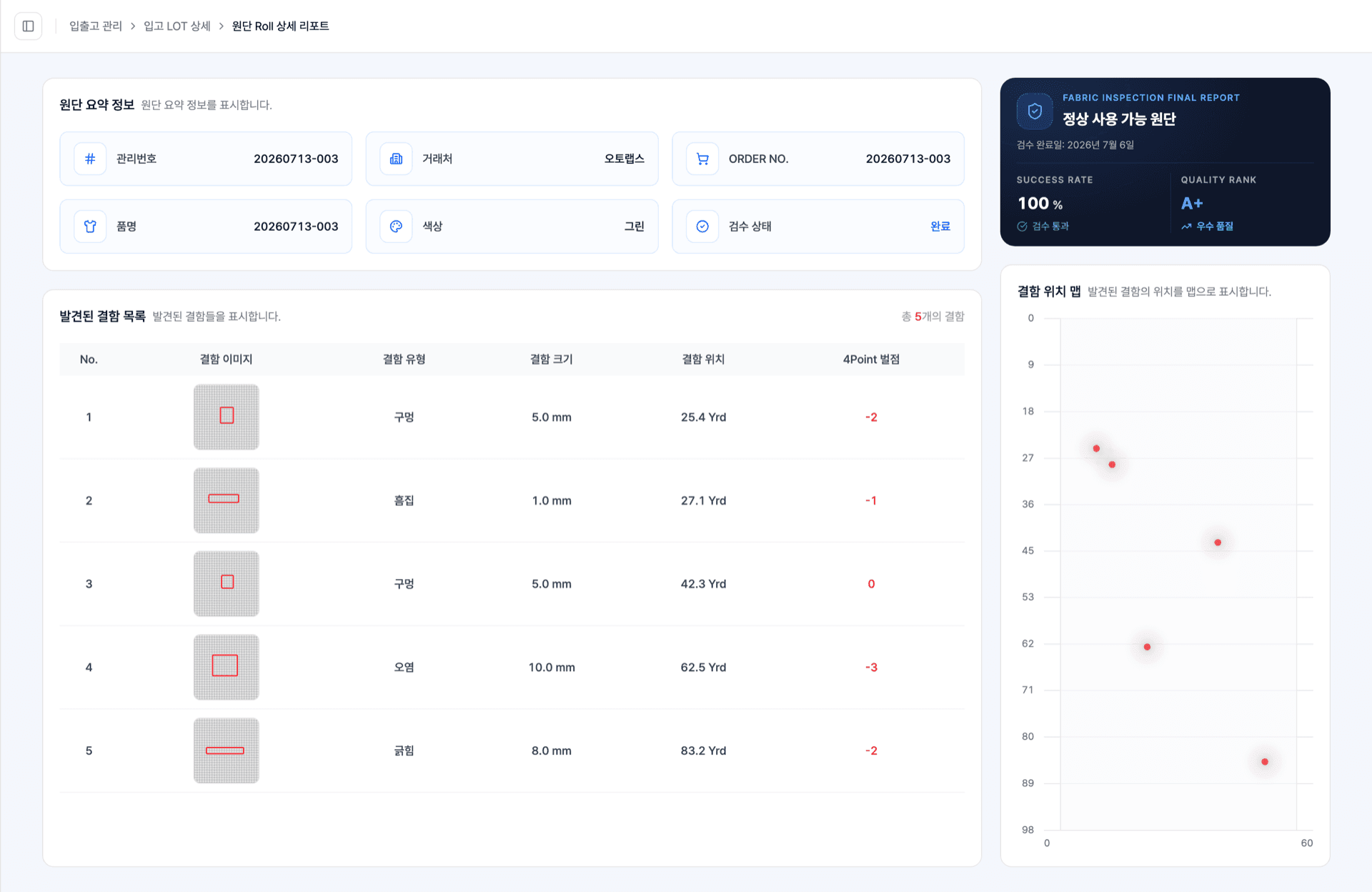
See inspection status right beside the line. When a defect appears, its position and type show up on the spot.
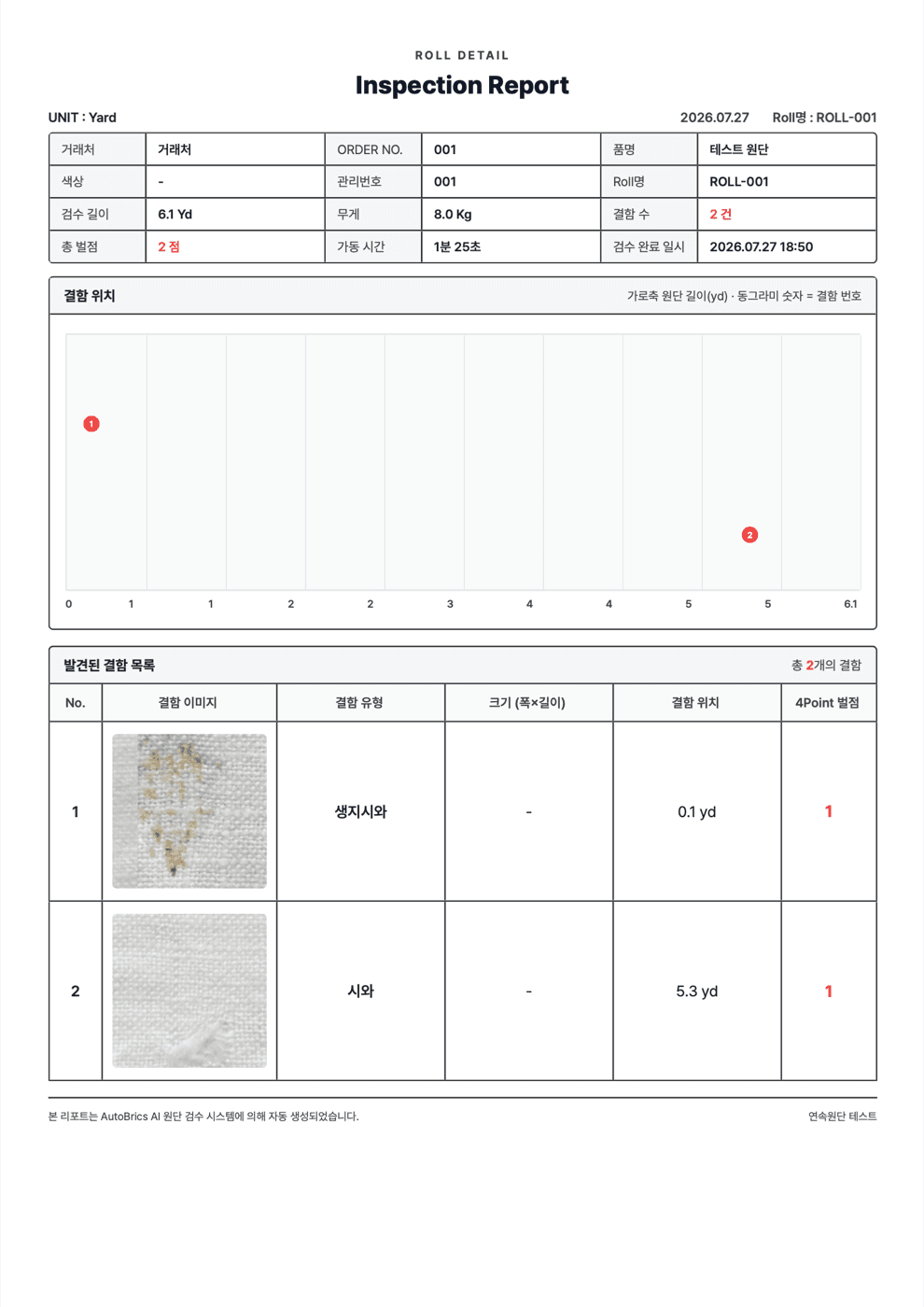
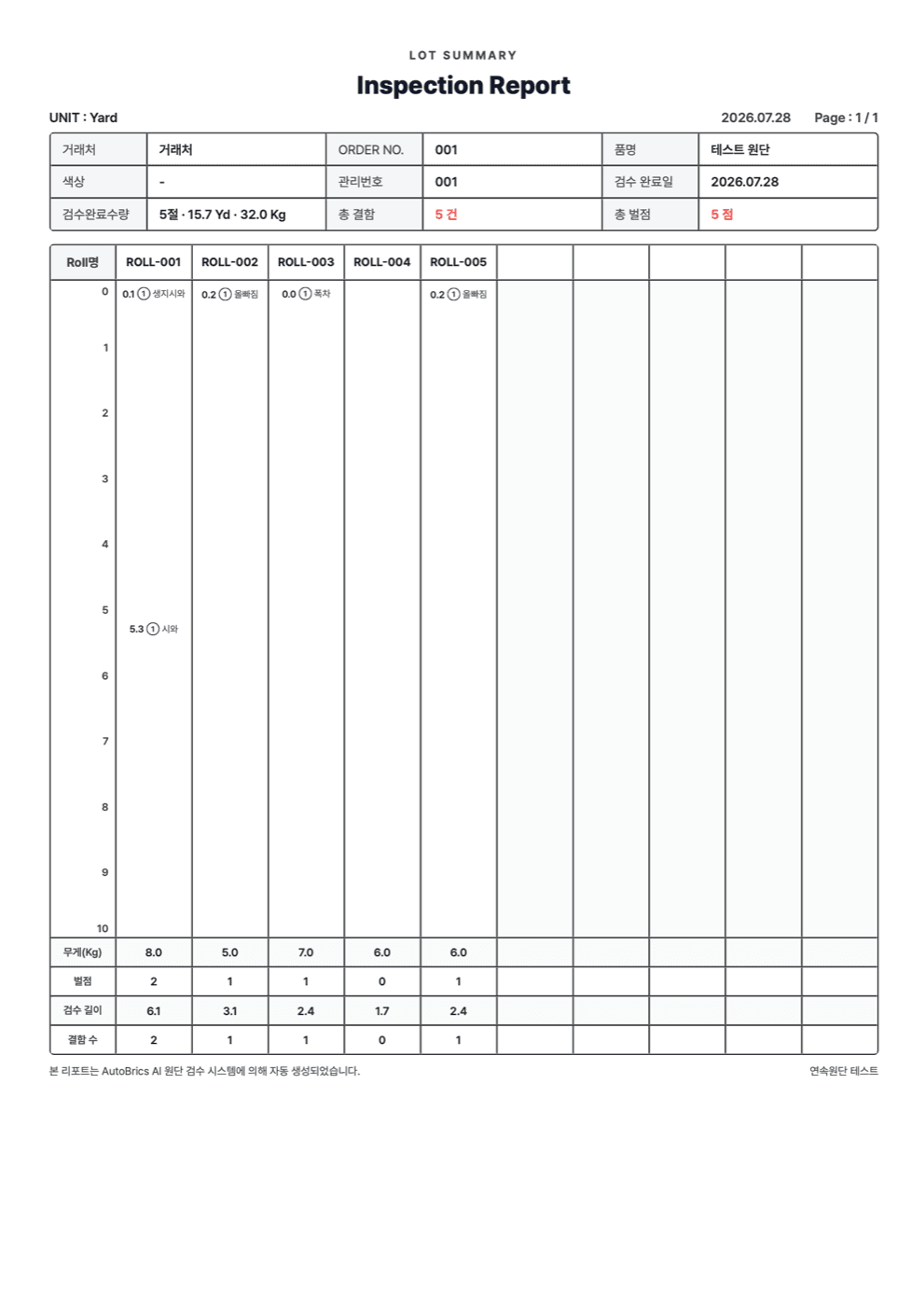
For every roll: a defect position map, type, size, and 4-Point score. Not a sample - a record of the whole roll.
Inspection time and original photos are saved automatically. You can prove "it wasn't there at shipment" and pull it out whenever needed.
The 4-Point System is the standard buyers and factories use most in the apparel industry to grade fabric (ASTM D5430). Until now, buyers have used it to judge factories. AutoCertificate lets the factory use it first: before shipment, each roll is scored and sent to the buyer as a standard-format quality certificate.
Inspect the whole roll
Calculate 4-Point score automatically
Create the standard certificate
Submit to buyer · original evidence in a dispute
About AutoLabs
Founded in 2025. Running proof-of-concept deployments on pulp and fabric lines in Korea, backed by global investors and technology partners.

Chief Executive Officer

Chief Operating Officer

Chief Technology Officer
Global investors and technology partners stand with AutoLabs.


Request a PoC
Request a proof of concept and see defect detection and grading on your actual fabric with your own eyes.